
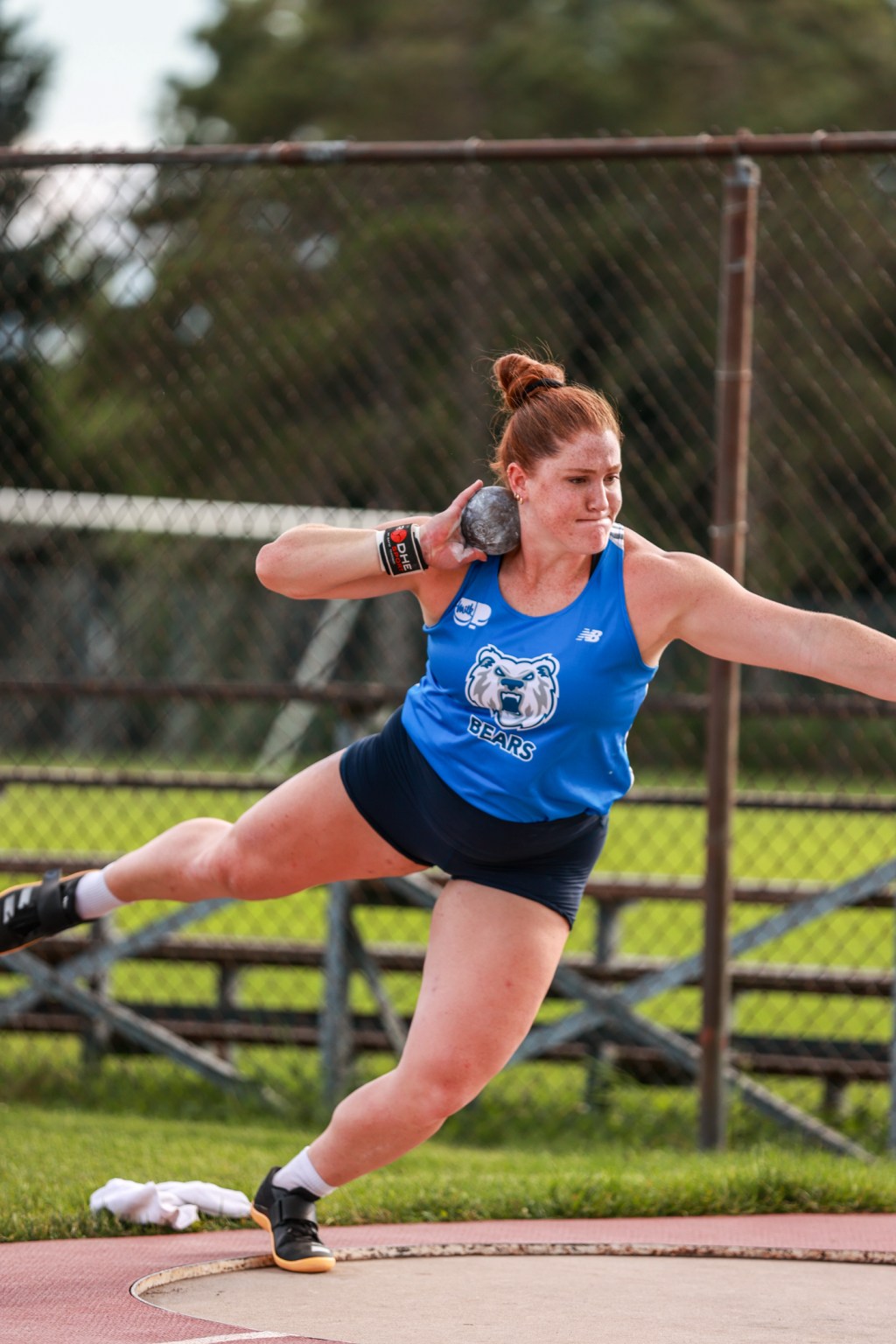
When Canadian shot putter Sarah Mitton left the circle after a disappointing opening round at the 2020 Tokyo Olympics, she decided to stick around and watch her competitors throw.
Mitton watched the rest of her group – which contained future gold medallist Gong Lijiao – and what she saw changed the way she approached the sport.
Already a dominant athlete within Canada, Mitton looked on at the women who qualified for the finals and felt they had something she didn’t. They gave everything they had each time they stepped in the circle, she said. There was no fear.
“I remember coming back and being like, ‘I’ve got to figure out how to attack a throw, no matter what the odds are against me,’” Mitton said. “No matter if it’s an Olympic final, no matter if it’s a meet at York University, I need to learn how to [take] every throw like a full throw.”
Mitton worked fearlessness into her gameplan. It became a part of her mentality and has helped her rise to international dominance since.
Three years after that moment in Tokyo, Mitton – a favourite at the Paris Olympics – faced another major setback that solidified the importance of fearlessness in the sport, as she quickly rose from a shocking disappointment to triumph on the world stage.
The Tokyo Olympics destroyed Mitton. After exiting the games in the qualifying rounds with an underwhelming 16.62m throw, she was left questioning her place in the sport.
“I thought I wasn’t going to be able to recover,” she said. “After Tokyo, I completely shut down. I had no motivation to train. I was contemplating whether or not I had space for myself in the sport mentally.”
It took some time, but there was a light at the end of the tunnel for Mitton.
“The next season… I had the best season of my life,” she said. “Just so many positive things kind of rolled out of the lessons that I had learned, and all of the darkness, per se.”
In months between her lowest in the sport and international dominance, Mitton said she learned valuable lessons.
One of the most important lessons she learned was dealing with disappointment. Mitton and her coach even coined a term for infrequent failures on the field – “swings and misses.”
Between Tokyo and Paris, Mitton won multiple national championships, the Commonwealth Games, Pan Am Games, NCAC Championships and placed second at the 2023 World Championships.
Coming off of an “awesome” 2023 season, Mitton said she felt ready for another Olympic year. Always strategic with her schedule, the 28-year-old was extra careful in choosing where she spent her energy before the games.
Setting two national records in the 2024 indoor season, Mitton was firing on all cylinders as she moved outdoors. Mitton said she found some much needed consistency in 2024.
Due to personal reasons, the months leading up to the Paris Olympics were turbulent outside of the sport for Mitton, and her performance wavered.
“There were so many ups and downs, emotionally, in those last four or five months, and so it’s just been so difficult,” Mitton said. “And you can kind of see it in training.”
“When things were good, things were good, and then, you know, I would have this dip.”
While her emotions ebbed and flowed, Mitton was at her best physically before the games. She showed exactly that through the Olympic qualifying round in Paris. She placed first in her group with a 19.77m throw and said that her “fearless” mentality helped her achieve that.
“I was like, ‘I’m going to take one big throw and I’m just going to walk out of here,’” Mitton said. “I felt like I was just untouchable. Just feeling so smooth, so focused, so everything.”
But in the finals the next day, Mitton said her confidence was washed away by the Parisian rain that drenched the Stade de France.
Mitton couldn’t find the success that she – and many watching the games – expected. After two sub-18 metre throws, Mitton narrowly fouled out on her third – and best – attempt, finishing twelfth.
“Usually I’m just able to get myself together. But at the Olympics, with everything going on and then, for me, the rain, unfortunately I just couldn’t get myself [together]. I didn’t have enough throws to, like, get myself back in it after the warm up,” she said.
“It was just so unexpected because I hadn’t had such a big miss in so long.”
Just like she did in Tokyo, Mitton stayed and watched those who made it further than her and was inspired by their ferocity in the circle, despite the less-than-ideal conditions.
“I watched some of these girls, like, throw and fall, and then get up and throw a big throw. And then I was like, ‘how the heck. Did you do that?’” she said.
Mitton said she felt defeated after her unexpected exit from the games. Despite a similar end, Mitton said her experience after Tokyo and Paris were very different because – unlike in Tokyo – she was prepared to deal with the disappointment.
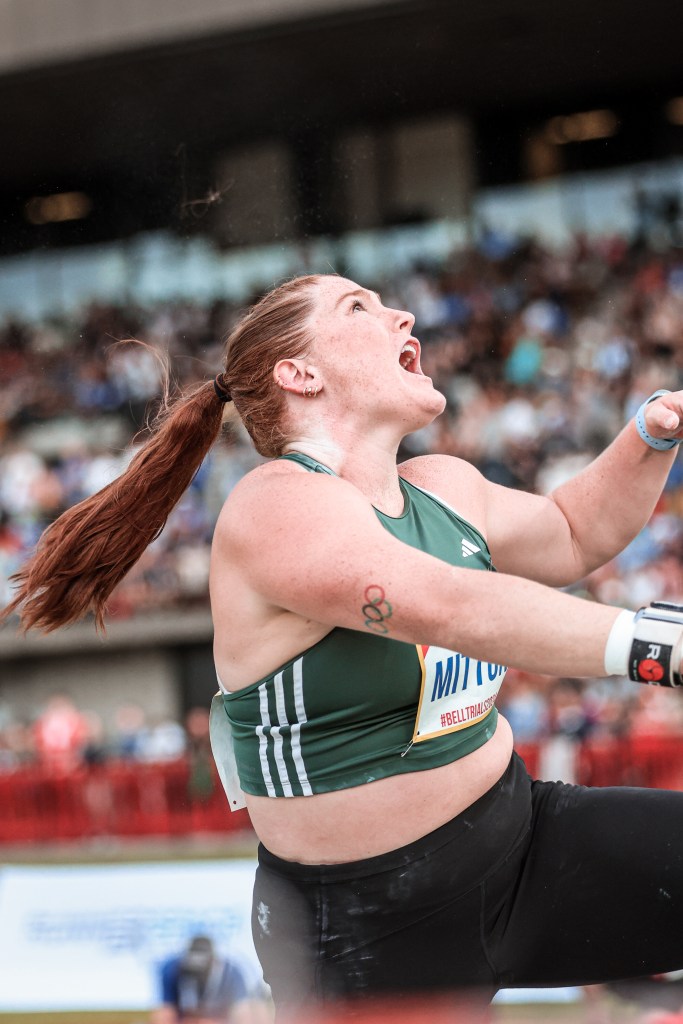
Before the games, she and her coach had already scheduled a series of meets to follow her time in Paris, regardless of the result. Mitton worked with sports psychologists to prepare a “mental plan” for various outcomes which she said helped her manage expectations and emotions after Paris.
She said her swift bounce back to success wouldn’t have been possible without the dark times that came out of Tokyo.
“I saw the other side. I saw the side where it was like, ‘ if it doesn’t go well, how do you prepare for that?’ Because I was so unprepared after Tokyo,” she said. “I think it was really from the lessons that we had before.”
Mitton’s realization that her season doesn’t end after the Olympics pushed her onward.
“We were just able to take it in stride this time, and understand that’s [the Olympic performance] not what we were hoping to achieve, and that we had just missed. [It was] a four year goal for us, but there’s so many more things to come.”
Exactly one week after the Olympic finals, Mitton threw 20.18m in the Internationaler Thumer Werfertag in Thum, Germany. In that competition, she said her thought process was “to just throw hard. And if I miss, and I throw 18.50 or something…That’s just what it’s going to be.”
With another world championship just after the Olympics, Mitton used her competitions in between to “attack every throw.” When she showed up to the Diamond League Final in Brussels, she tried to visualize it as any other competition, no matter the stakes.
Just like in Paris, Mitton was thrown off by the environment. She said many watching couldn’t see, but the pole vault runway was “so close” to the shot put circle.
“I was just so frustrated with the circumstances,” Mitton said.
One month after that same frustration made her crumble, Mitton persevered and threw 20.25m to win her first Diamond League Finals.
“It’s crazy,” she said. “Now, with eight years or so in the making, like, how quickly those lessons can come.”
Now in her offseason, Mitton is focused on making a “big” throw like her 20.25m, the new normal for the 2025 season.
“There’s excitement, obviously, to get back ending the [season with a] diamond league like that, but also to just get back to work and see how much further you can push it in just one year,” she said.
Now 28, Mitton said she is looking to prioritize her health. She and her team plan to refine her schedule, increasing “quality sessions,” and finding more time for recovery.
After a season filled with wins and losses – on and off the field – Mitton said there is one thing above all she will take into the future.
“Fearlessness,” she said.
“I think I learned in Tokyo, but it was really solidified in Paris this time where it’s like, ‘you’re going to be fine either way. You’re going to have success. Either way, you just got to come out every day and try to throw far.’”



 New World Athletics Network
Leave a comment